How long does a criminal record last in England?
16/07/2026
If you have been convicted of a criminal offence or received a caution, one of the most common questions is how long it will follow you. The short answer is that a criminal record itself does not usually disappear, but the law recognises that people should not be defined by past mistakes forever. The Rehabilitation of Offenders Act 1974 (ROA) sets out when a conviction becomes “spent”, meaning you no longer need to disclose it in some circumstances.
Understanding the difference between the record existing and the record being disclosable is the key to knowing where you stand.
What is a criminal record?
A criminal record is created when you are convicted of an offence, or in some cases when you accept a caution. The details are held on the Police National Computer (PNC) and are usually retained until you reach 100 years of age. In practical terms, the record itself is permanent.
What changes over time is whether you must declare it, and whether it will appear on a Disclosure and Barring Service (DBS) check.
Spent and unspent convictions
Under the ROA, most convictions become “spent” after a set period known as the rehabilitation period. Once spent, you are not required to disclose the conviction to most employers, insurers or others, and it should not usually be held against you.
For most jobs, once a conviction is spent, you do not need to disclose it. However, certain roles are “excepted” from this protection under the Rehabilitation of Offenders Act 1974 (Exceptions) Order 1975, meaning employers can lawfully ask about, and you must disclose, spent convictions and cautions. This typically applies to roles in areas such as health and social care, law and justice, education and childcare, financial and regulatory roles, and security and public safety.
Current rehabilitation periods
Following changes brought in by the Police, Crime, Sentencing and Courts Act 2022, and in force since 28 Octover 2023, the main rehabilitation periods for adults in England and Wales are:
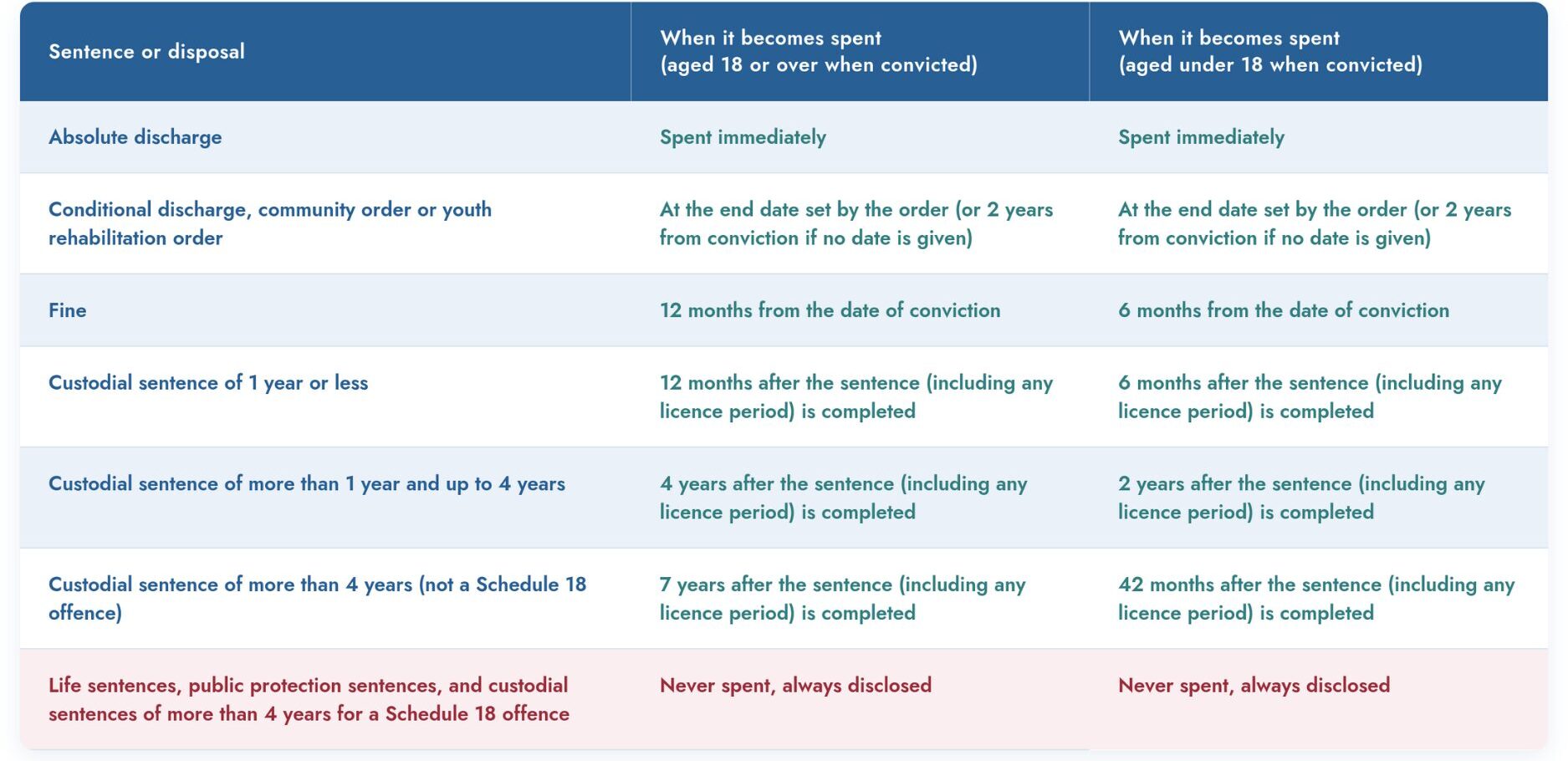
For further information, please visit the GOV.UK rehabilitation periods guidance, the official source for rehabilitation period information, or click here for the full list of Schedule 18 offences.
What about cautions?
A police caution is a formal legal warning issued out of court for minor crimes. To receive one, a person must admit to the offence and accept the caution. There are two main types: simple cautions, used to resolve minor offences like petty theft immediately, and conditional cautions, which require the person to meet certain conditions, such as attending a drug rehabilitation programme.
Cautions are treated differently from convictions:
- A simple caution is treated as spent immediately.
- A conditional caution becomes spent three months after it is given, or earlier if the conditions are met.
- Youth cautions are spent immediately, and youth conditional cautions are spent when the conditions cease to have effect, or three months after being given, whichever is sooner.
DBS checks and filtering
Even once a conviction is spent, it can still appear on certain background checks. Basic DBS checks only show unspent convictions and conditional cautions, but standard and enhanced DBS checks can also show spent convictions and cautions unless they are “filtered” out under separate rules.
Why it matters
Whether a conviction is spent affects far more than job applications. It can influence other areas such as visas, international travel, and professional registration. Getting it wrong, either by disclosing when you do not need to, or by failing to disclose when you do, can have serious consequences.
Speak to our criminal defence team
If you are facing a police investigation, have been invited to a voluntary interview, or are dealing with proceedings at the magistrates’ or Crown Court, it is important to get expert legal advice as early as possible.
Our experienced criminal defence solicitors combine decades of experience and have supported clients across Liverpool, Halton and Cheshire, and we are on hand to guide you through every step of the process, from your first police interview through to representation in court.
Learn how we can help: https://jrlevins.co.uk/services/criminal-defence-solicitors-liverpool/