NHS Voluntary Redundancy Guide: What to Check Before Applying or Signing
03/07/2026
Being offered voluntary redundancy can feel like a lot to take in. For some NHS employees, it may come as a relief. For others, it may feel sudden, unsettling or unclear. You may be looking at an expression of interest form, a MARS offer, a redundancy calculation or a settlement agreement and wondering what it all means in practice.
The important thing is not to rush! Before applying, accepting or signing anything, you should understand what type of arrangement is being offered, what you may be paid, what rights you may be giving up, and whether there are any restrictions that could affect your next step.
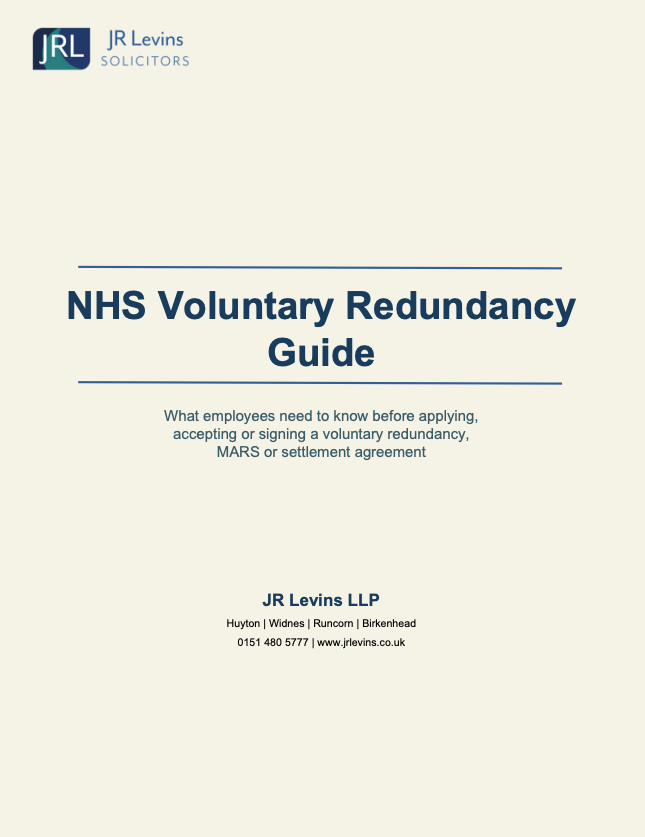
JR Levins has created a free NHS Voluntary Redundancy Guide for employees who want to understand the process before making a decision. This article gives an overview of the main points to think about. The full guide includes more detailed checklists, HR questions, document lists and settlement agreement watch-outs.
Have you been offered voluntary redundancy, MARS or a settlement agreement?
NHS employers may use different terms when discussing exit arrangements. These terms can sound similar, but they do not always mean the same thing.
You may see references to:
- voluntary redundancy;
- MARS, which means Mutually Agreed Resignation Scheme;
- a settlement agreement;
- early retirement;
- an agreed exit package;
- a reaffirmation certificate.
This can be confusing, especially when paperwork arrives with a short deadline. It is a bit like being handed several forms at once and being expected to know which one matters most. In reality, each document may have a different legal or financial effect.
The wording matters because it can affect your redundancy payment, notice pay, pension position, ability to return to NHS work, and employment rights.
Is NHS voluntary redundancy the same as resigning?
Usually, no.
Voluntary redundancy is normally linked to a redundancy, restructure or cost-saving process. You are volunteering to leave, often in return for a redundancy payment or enhanced package.
Resignation is different. That is where you choose to leave your job, usually without receiving a redundancy payment.
However, some NHS exit schemes use language such as “mutually agreed resignation”. This is where MARS can cause confusion. Although MARS includes the word “resignation”, it is usually a specific exit arrangement with agreed terms.
Before applying, check whether you are being asked to:
- express an interest;
- make a formal application;
- resign under a MARS arrangement;
- accept voluntary redundancy;
- sign a settlement agreement.
Do not assume these all mean the same thing.
Can I be forced to apply for voluntary redundancy?
Voluntary redundancy should be voluntary, your employer should not force you to apply. However, if not enough people volunteer, your employer may later consider compulsory redundancies. That would usually involve a separate process, including consultation and fair selection where relevant.
If you feel pressured, or you are being told you ‘have no real choice’, it is sensible to take advice before agreeing to anything.
This is especially important if you are on sick leave, maternity leave, long-term absence, or you believe your treatment may be connected to disability, pregnancy, age, race, sex, religion, sexual orientation or another protected characteristic.
Can my employer refuse my application?
Yes, in most voluntary redundancy schemes applying does not mean your employer must accept.
Your employer may refuse an application if your role is still needed, your skills are difficult to replace, your department would be left short staffed, or accepting your application would affect service delivery.
This can be frustrating. An employee may spend days weighing up the decision, only to find the employer says no. However, voluntary redundancy is usually a two-way process. You can volunteer, but the employer normally decides whether the application can be accepted.
If your application is refused, you can ask for the reason in writing.
Can I change my mind after applying?
This depends on the scheme wording and the stage you have reached.
Some schemes start with a non-binding expression of interest. Others treat an application more formally. In some cases, you may be able to withdraw before a certain deadline. In others, it may become difficult once your application has been accepted.
You should ask:
- whether the application is binding;
- whether you can withdraw;
- when the withdrawal deadline is;
- when the agreement becomes final;
- whether the employer can withdraw the offer.
Once a settlement agreement has been signed and completed, it is usually intended to be legally binding. That is why it is important to ask questions before you sign, not afterwards.
What should I check before applying for NHS voluntary redundancy?
Before applying, think carefully about the practical impact.
For many people, the first question is simply: “Can I afford to do this?” That is understandable. You may need to consider your mortgage or rent, household bills, childcare, debts, savings and how long it may take to find another role.
However, money is only one part of the picture.
You should also think about:
- whether your role is genuinely at risk;
- whether compulsory redundancy may follow if you do not apply;
- whether you want to stay in the NHS;
- whether future NHS work could be restricted;
- whether your pension may be affected;
- whether you have unresolved workplace concerns;
- whether suitable alternative employment may be available;
- whether you are being asked to waive legal claims.
A payment can look attractive at first glance. However, it may feel very different if it affects your pension, limits your ability to return to NHS work, or requires you to give up claims you have not properly considered.
What payments should I check?
Before accepting voluntary redundancy or signing a settlement agreement, check what payments are included.
These may include:
- redundancy payment;
- notice pay;
- accrued holiday pay;
- final salary;
- overtime or enhancements;
- allowances;
- pension-related sums;
- any agreed additional payment.
You should also check how each figure has been calculated.
For example, if your payment is based on length of service, age, weekly pay or an enhanced scheme, make sure the details used are correct. Small errors can make a real difference.
Tax is another important point. Some redundancy payments may be paid tax-free up to a certain limit, while other payments, such as notice pay, holiday pay and salary, are usually taxable. The agreement should make this clear.
If something has been promised verbally, ask for it to be confirmed in writing. A friendly conversation with HR may be helpful, but it is the written agreement that usually matters.
Could voluntary redundancy affect my ability to get another NHS job?
It may do, as some NHS voluntary redundancy, MARS or settlement agreement arrangements include restrictions on returning to NHS employment for a period of time.
These restrictions may apply to:
- permanent NHS roles;
- fixed-term roles;
- bank work;
- agency work;
- consultancy work;
- returning to the same Trust;
- working for another NHS organisation.
There may also be repayment clauses. This means you could be required to repay some or all of the money if you return to NHS work too soon.
This is an area where assumptions can be risky. Someone may think, “I will take the package now and pick up bank shifts later.” That may be possible in some cases, but it depends on the wording. Check before relying on it.
Why does a settlement agreement matter?
A settlement agreement is a legal contract between you and your employer.
It usually records the terms of your exit and confirms that, in return for receiving an agreed payment or package, you agree not to bring certain employment claims against your employer.
A settlement agreement may deal with:
- your leaving date;
- redundancy payment;
- notice pay;
- holiday pay;
- tax wording;
- confidentiality;
- agreed reference;
- return of property;
- future restrictions;
- claims being waived;
- legal adviser details.
A settlement agreement is not just routine paperwork. It can affect your legal rights and your options after employment ends.
For a settlement agreement to be legally valid, you must receive independent legal advice before signing. This is because you are usually giving up important employment rights.
Do I have to sign a settlement agreement?
You cannot usually be forced to sign a settlement agreement.
However, if your employer says the enhanced voluntary redundancy or MARS package is only available if you sign, then refusing to sign may mean the package is withdrawn.
That does not mean you should sign without checking it. It means you should get proper advice before deciding.
Before signing, make sure you understand:
- what you are being paid;
- what claims you are giving up;
- whether the payment figures are correct;
- whether the tax wording is clear;
- whether future work is restricted;
- whether there are repayment clauses;
- whether you need to sign anything after your leaving date.
If something is unclear, raise it before signing.
Do I need legal advice for an NHS settlement agreement?
Yes, if you are being asked to sign a settlement agreement.
Your solicitor’s role is to explain the terms and effect of the agreement. This includes what you are being paid, what restrictions apply, what rights you are waiving, and whether anything needs to be clarified.
Your solicitor is independent. They do not act for your employer, even if your employer contributes towards the cost of advice.
In many NHS settlement agreement cases, the employer contributes towards the cost of independent legal advice. If the agreement is standard, that contribution may cover the usual advice required. If further work is needed, such as negotiations or advice on wider employment claims, your solicitor should explain any additional costs before carrying out that work.
What should you do before making a decision?
Before applying, accepting or signing, take time to gather the facts.
At this stage, you do not need to know every legal answer. You simply need to avoid making a decision based on incomplete information.
A sensible first step is to check:
- what type of arrangement is being offered;
- whether your application is binding;
- whether you can withdraw;
- how your payment has been calculated;
- whether your pension may be affected;
- whether future NHS work is restricted;
- whether you will need to sign a settlement agreement;
- whether there are any unresolved workplace concerns.
The full JR Levins guide includes a more detailed list of HR questions, documents to gather and checks to complete before signing.
Not sure what to ask HR?
Our free NHS Voluntary Redundancy Guide includes practical questions to ask before deciding, plus a list of documents to gather before taking legal advice.
If you are an NHS employee and you have received voluntary redundancy paperwork, a MARS offer or a settlement agreement, JR Levins can help you understand what the documents mean before you sign.
We can review the agreement, explain the terms in plain English, check the key clauses and advise you on the effect of signing.
Where appropriate, we can also raise questions or proposed amendments with your employer or their representative.
JR Levins advises NHS employees across Liverpool, Huyton, Widnes, Runcorn, Birkenhead and the wider Merseyside area. Appointments can usually be arranged in person or by Teams.
If you are unsure about the paperwork, the important thing is to ask before signing.
Download our free NHS Voluntary Redundancy Guide
The full guide includes:
- questions to ask HR;
- documents to gather before taking advice;
- payment and settlement agreement watch-outs;
- points to check about future NHS work;
- a final checklist before signing.
Ready to talk it through?
If you would like to speak to someone about your NHS settlement agreement, Jon Heath and our employment law team is here to help.
Merseyside: 0151 480 5777
Widnes: 0151 423 3661
Runcorn: 01928 711119
Speak to our employment law team